In memory
Ernest Hemingway, letter to Gerald and Sara Murphy, 1935
What they left behind, put back where it happened.
A Family Story Map takes what they left, a memoir, a recording, a box of photographs, a page of names and towns, and puts it back on the map of the world they actually moved through.
Every place opens with its photograph and the passage that belongs to it. Their name on the family tree draws their whole road across the map, from the house they were born in to the last place they lived. Everyone opens the same link, each in the language they read.
There is no hurry in this, and no date you have to meet. The material keeps. When the family is ready, we begin.
The map shown here is our own family’s. We published it on purpose, so you can see exactly what you would be getting. Yours stays private unless you tell us otherwise.
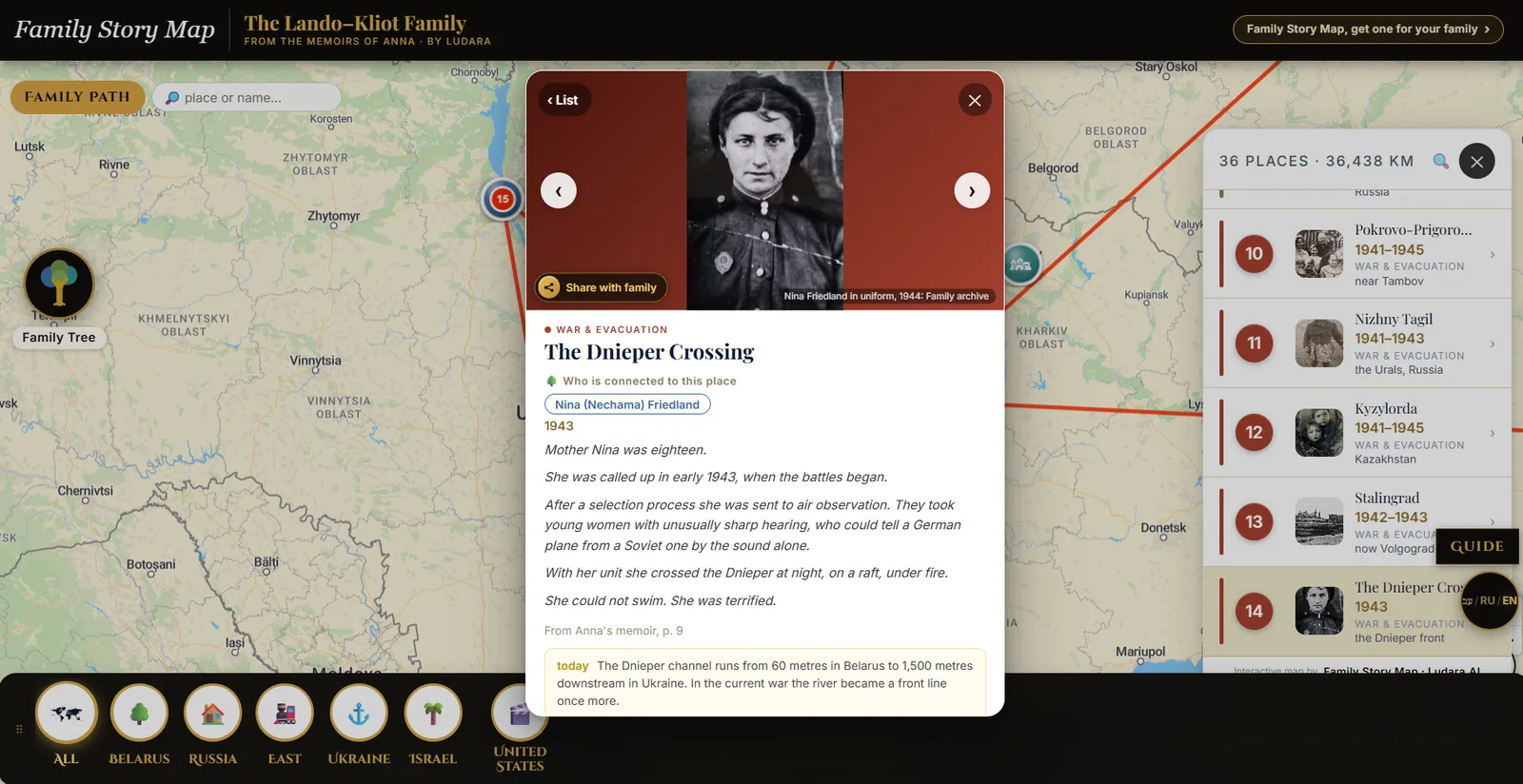
Above: one place, opened. The photograph from the family’s own archive, the person connected to it, the year, and the passage exactly as it was written, in this case a girl of eighteen crossing the Dnieper at night on a raft, under fire, who could not swim. Underneath, a line on what stands there today. This is what every place in a family map looks like.
See it in use
What a family gathering can become
It happens in every house. At the meal after the funeral, during the thirty days, at the unveiling of the stone, at the gathering a year later. Somebody brings out a box. The albums end up open on the table, the photographs go round the room, and an aunt looks at one and says: that is not Odessa, that is the house in Vitebsk, and your grandfather is the boy on the left.
For an hour or two the whole family is in one place, remembering out loud, and every single one of them is holding a different piece of it. That does not happen twice. The cousins fly home, the boxes go back into the cupboard, and everything that was said in that room stays in that room.
So use the gathering, on purpose. Put the albums on the table rather than waiting for somebody to find them. Ask the oldest person there who is in each photograph, and write it on the back while they are still standing beside you. Let a phone record in the corner while the stories are being told, badly, with the tea going cold. Nothing has to be organised, and nobody has to be a historian.
Then send us what came out of that afternoon. We put it back on the map of the world your family actually crossed, every place opening with its photograph and the words that belong to it, so the day carries on working long after everybody has driven home. The children who were too small to follow any of it can open the whole thing at fifteen, and again at forty, and know exactly who they came from.
A memorial that keeps growing, rather than one that is finished on the day it is unveiled.
What they open
One link opens in every language your family reads, and each reader picks their own. Stories, names, tree and every button switch together. Shown with the family’s permission.

The whole journey, in the order it happened. One tap numbers every stop and draws the road between them, and the regions along the bottom filter the map to one chapter at a time.

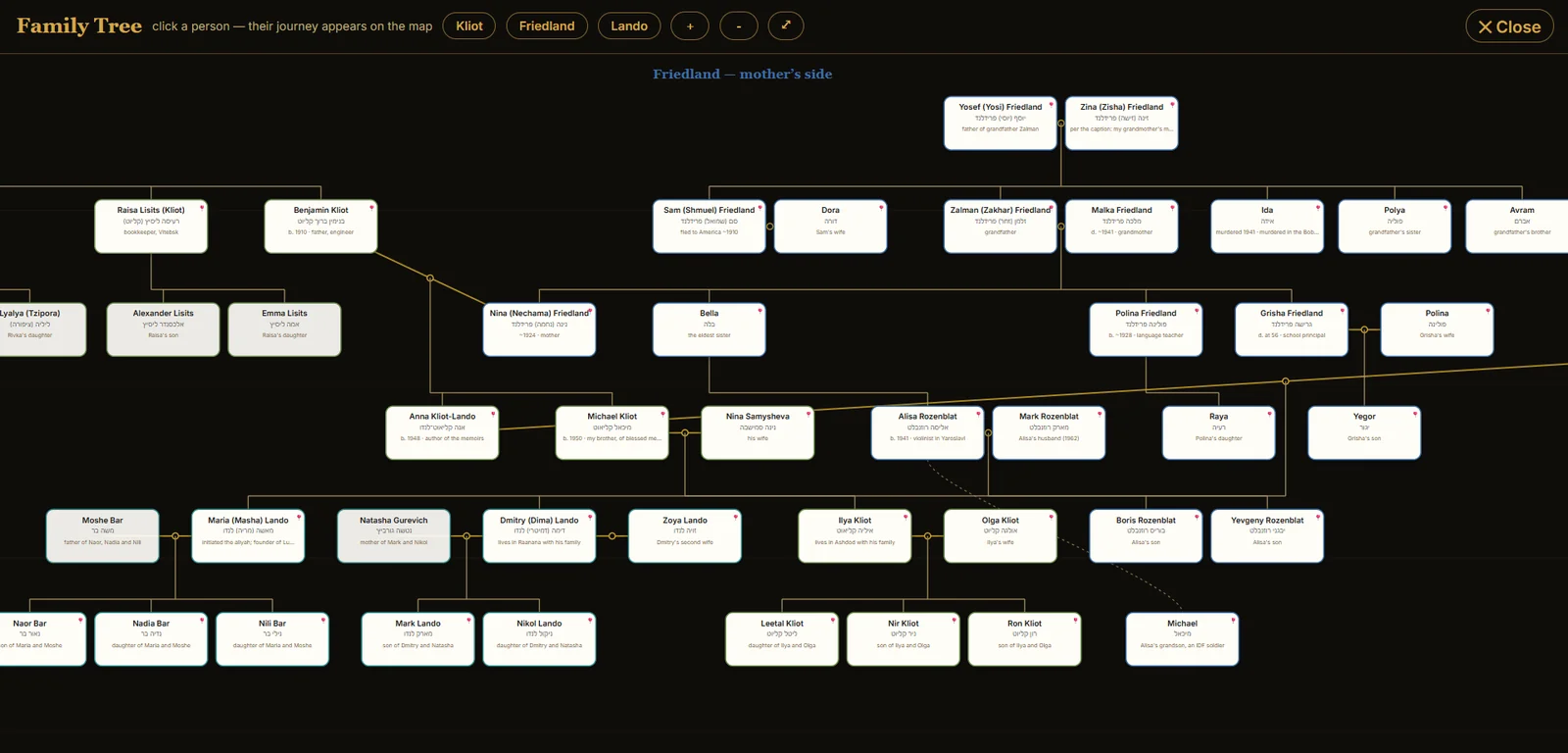
A family tree, interconnected with the map. Eighty six people across five generations in this one, each name in its own languages. Click any person and their journey draws itself, from the house they were born in to the country they ended in. The grandchildren find themselves at the bottom of it, which is usually the moment they start paying attention.

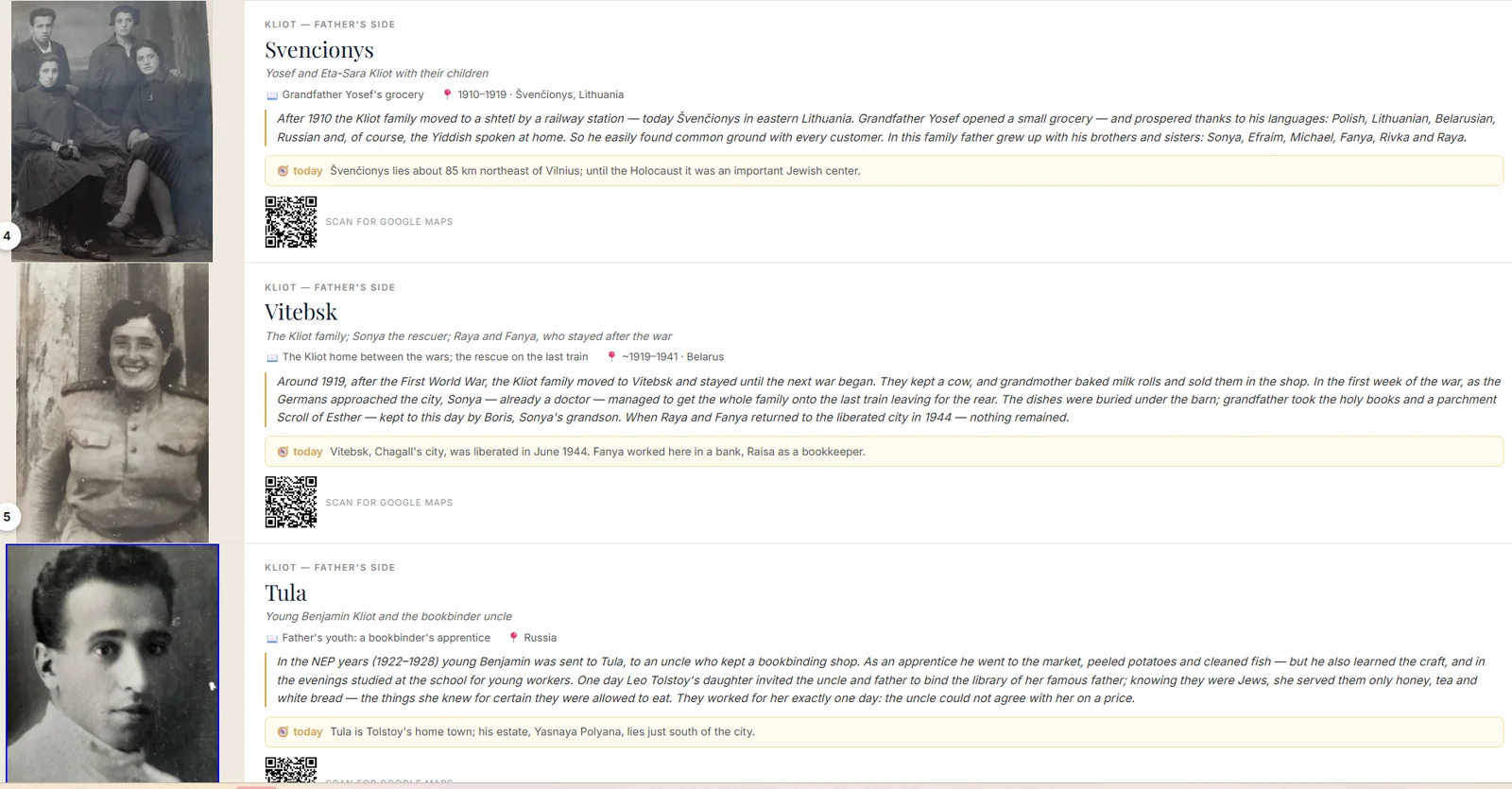
And it prints as a book. Any selection of places exports to a PDF: the photograph, the story in the family’s own words, and a QR code that opens the location. Print a copy for the relatives who would rather hold paper than open a link.
When families ask us for this
Something to give the others when the visits stop and the house goes quiet: at the end of the thirty days, at the unveiling of the stone, or on the first anniversary. One link, sent to everyone who came.
A card says the dates and the name. A map holds their towns, their photographs, their own words, and room for whatever the family remembers later, because they will remember more later.
Children who were five at the funeral grow up with almost nothing of the person. A map they can open at fifteen, and again at thirty, is a different inheritance from a box in a cupboard that nobody opens.
Before the flat is cleared, photograph the papers. All of them, badly, on a phone, in a pile if that is all you can manage. The certificates, the passports, the letters in a language you cannot read, and above all the backs of the photographs, because the backs are where the names are written.
Nothing has to be sorted. Nothing has to be understood today. It only has to still exist in a year, when somebody in the family is finally able to look at it.
Most of what families lose is not lost in a war or a fire. It is lost in the week the flat is emptied, by people who are too tired to know what they are throwing away. If we can spare you that, this page has done its job, whether or not you ever become a client.
And one more thing we would rather say plainly, even though it costs us the work. If the person is still with you, this is the time to ask. An hour recorded on a Sunday afternoon is worth more than any archive, and no amount of research afterwards will replace their voice. Spend the afternoon with them. We will still be here.
“Wow! The map brought my family together from across the globe. Relatives from Belarus and Israel are reviewing it together, in different languages, and discussing today.”
How it works
A memoir, a recording, a tree file, a folder of documents, a box of photographs, or just a list of names and towns.
We find each place as it exists today, including towns that were renamed, and check every one against the record.
The map goes live on a private link, in the languages your family reads, with the tree, the path and the photographs in place.
Once the family sees the map, new photographs and memories surface. One update round in the first year is included.
Almost every family says the same sentence first: we have nothing, nobody wrote anything down. Then it turns out there is a folder of documents, a handful of photographs with something written on the back, and an afternoon of what two or three relatives still remember between them. That is enough to build from. The research is our part, not yours.
Where the record is unclear, or two relatives remember it differently, we come back to you rather than choose. Nothing is invented, nothing is filled in to round out a story, and nothing is made sadder or braver than it was. If a place cannot be found, the map says so.
You will not be chased. If you write and then go quiet for four months, that is a completely normal thing to do, and your material sits where you left it until you come back.
What it costs
A map built from a written family history starts at $3,000. It is commissioned work, made once for one family, not a template. You pay once. There is nothing to renew, nothing to keep paying for, and no anniversary email from us reminding you what month it is.
You do not have to decide about the whole family today, and this is not the week for big decisions. Send us five places from their life. The town they were born in. The place they were sent to in the war. The street they first lived on here. We research each one, find it even if it has been renamed twice, and put all five on a real map with the family’s own words beside them.
One language, ready in a week. If you go on to the full family map afterwards, the whole $195 comes off the price.
Five researched places on a map, and that is what it is. The family tree, the whole journey drawn in the order it happened, the additional languages, the PDF book and the update round belong to the full map. This is the way in, not a smaller version of it.
The story is written down somewhere already: a memoir, a recording, a family history, a folder nobody has been able to open yet. We do the rest.
Tell us which languages your family reads and we confirm them in the offer, before you commit to anything.
Questions we are asked
A map of the life they lived, built from what they left: a memoir, a recording, letters, documents, photographs, or only names and towns. Every place they lived opens with its photograph and the passage that belongs to it, and their name on the family tree draws their whole road across the map. It becomes a memorial the family can open from anywhere, rather than a box in a cupboard.
Yes. Almost every family says the same sentence first, that nobody wrote anything down, and almost every family turns out to have more than they thought. Documents, photographs with something written on the back, and an afternoon of what two or three relatives remember between them is enough to build from.
Yes, and it costs nothing. Before the flat is cleared, photograph the papers. All of them, badly, on a phone, especially the backs of the photographs, because the backs are where the names are. Most of what families lose is lost in the week the home is emptied.
There is no right time and no date you have to meet. Families come to us at the end of the thirty days, at the unveiling of a stone, on a first anniversary, and years later with no occasion at all. Your material sits where you left it until you write again, however long that takes. You will not be chased.
Only the people you send it to. Every map ships on an unlisted link that search engines cannot find, and it can be locked further with a password or limited to named people. We never publish a family map or quote from it without written permission.
Yes, and families almost always do. Once the map exists relatives start remembering, and photographs surface that nobody knew existed. One update round in the first year is included, and further rounds can be bought whenever you want one, never on a schedule.
A family story is not a publication. Every map ships on an unlisted link that search engines cannot find, and you decide who gets it. If you want it tighter than that, say so:
We never publish a family’s map, quote it, or show it as an example without written permission. If you would rather it were public, that is your decision, not ours.
Write a few lines about what is in the house. A memoir, a recording, documents, photographs, or only names and towns. You do not need to know what you want yet. We answer within one business day, and if it is too soon, say so and we will simply keep it on file until you write again, however long that takes.
We will be in touch within one business day.