Where your ancestors came from, on one map · A Family Story Map · Ludara.AI

For families whose stories span continents

So where are we from,
actually?

A child asks it in the car, or across the dinner table, with no idea that it is a difficult question. You give the answer you have: a country, and if you are lucky a city. Then they ask the second question. Where exactly. What was it like. Why did we leave. And your answers get shorter, because after the first sentence you are repeating something somebody told you once, in a kitchen, in another language, when you were too young to be listening properly.

It is not that the story was never told. It was told in pieces, out of order, by people who assumed there would be another chance to tell it.

And now you are the one being asked. The people who could have filled the gaps are getting older, and the ones who could have filled them completely are already gone.

The map shown here is our own family’s. We published it on purpose, so you can see exactly what you would be getting. Yours stays private unless you tell us otherwise.

The whole family map with the journey drawn: numbered stops running from Belarus and Lithuania through Russia, Kazakhstan and Ukraine to Israel, then across the Atlantic to Los Angeles and Boston, with region filters along the bottom

Above: the first Family Story Map, built from one grandmother’s memoir. One tap numbers the stops in the order they happened, from Bobruisk and Vitebsk out to the Urals and Kazakhstan, on to Los Angeles and Boston, and home to Israel. Every place is listed down the side with its portrait and its dates, every pin opens into its photograph and its story, and the regions along the bottom filter the map to one chapter at a time.

See it in use

Video: the Family Story Map open on a laptop, the journey drawn across Europe and North America, with a place card open beside it

What we do about it

We put the whole journey back on the map, under the names those places carry today.

We find every place your family lived as it stands now, and put them back on it. Every stop opens with its photograph and the passage that belongs to it, and one tap draws the whole journey in the order it happened, from the town they left to the street you live on.

Your parents read it in the language they were born into, you read it in the one you grew up speaking, and your children read it in English, all from the same link. Nobody is handed a second class version, because there is no original and no translation. There is one map, with three readings.

And it stays. Long after you are the one everybody asks, it will still be there, in the language they read, waiting for a grandchild who has not been born yet.

What they open

One map, and every generation reads it in its own language.

One link opens in every language your family reads, and each reader picks their own. Stories, names, tree and every button switch together. Shown with the family’s permission.

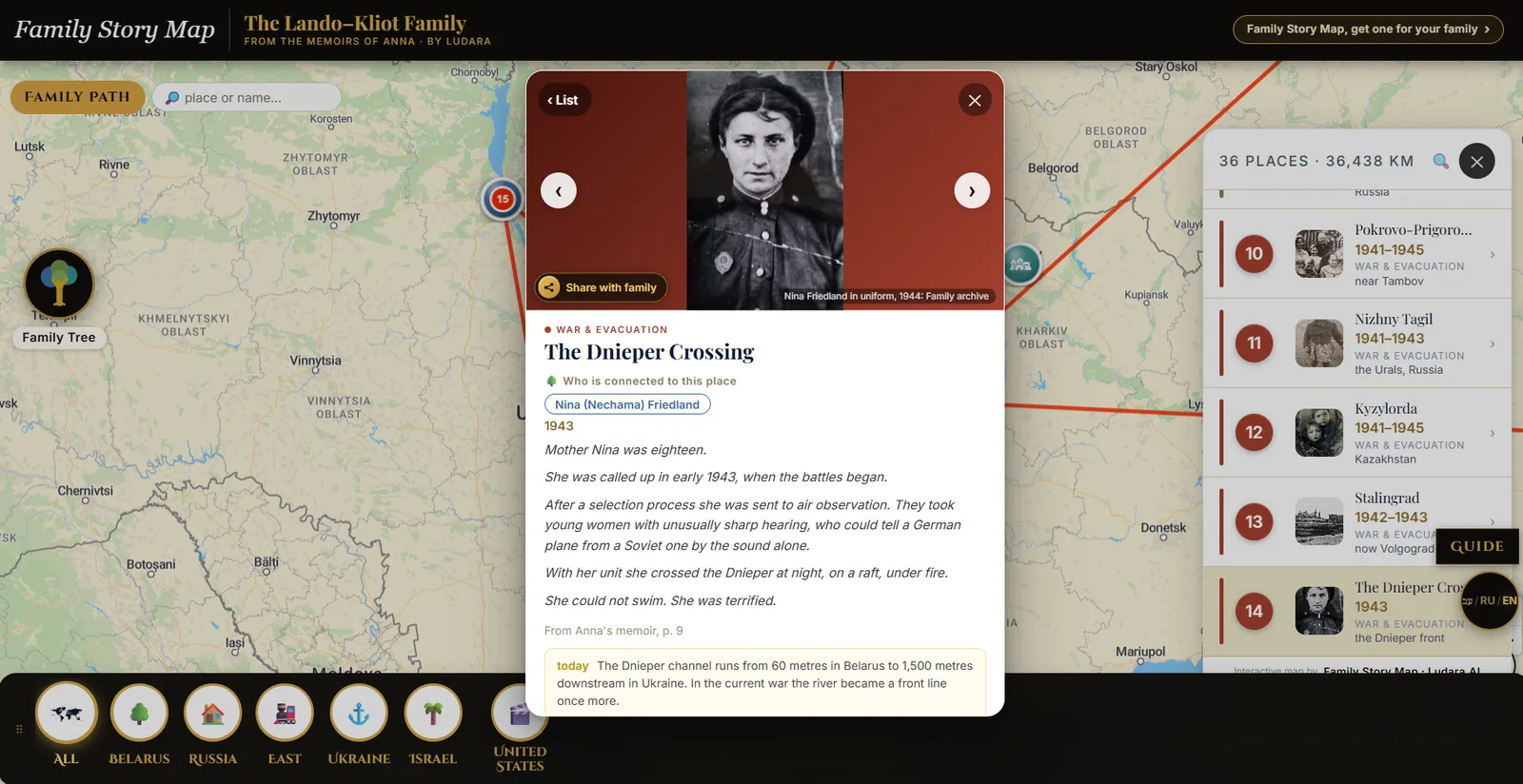
A place card open over the map: the archive portrait of an eighteen year old woman in uniform, the family member connected to the place, the year 1943, and the passage from the memoir describing her crossing of the Dnieper

Open a place and the story is waiting. The archive photograph, who in the family is connected to it, the passage in the writer’s own words, and a line on what stands there today. Nothing paraphrased, nothing invented.

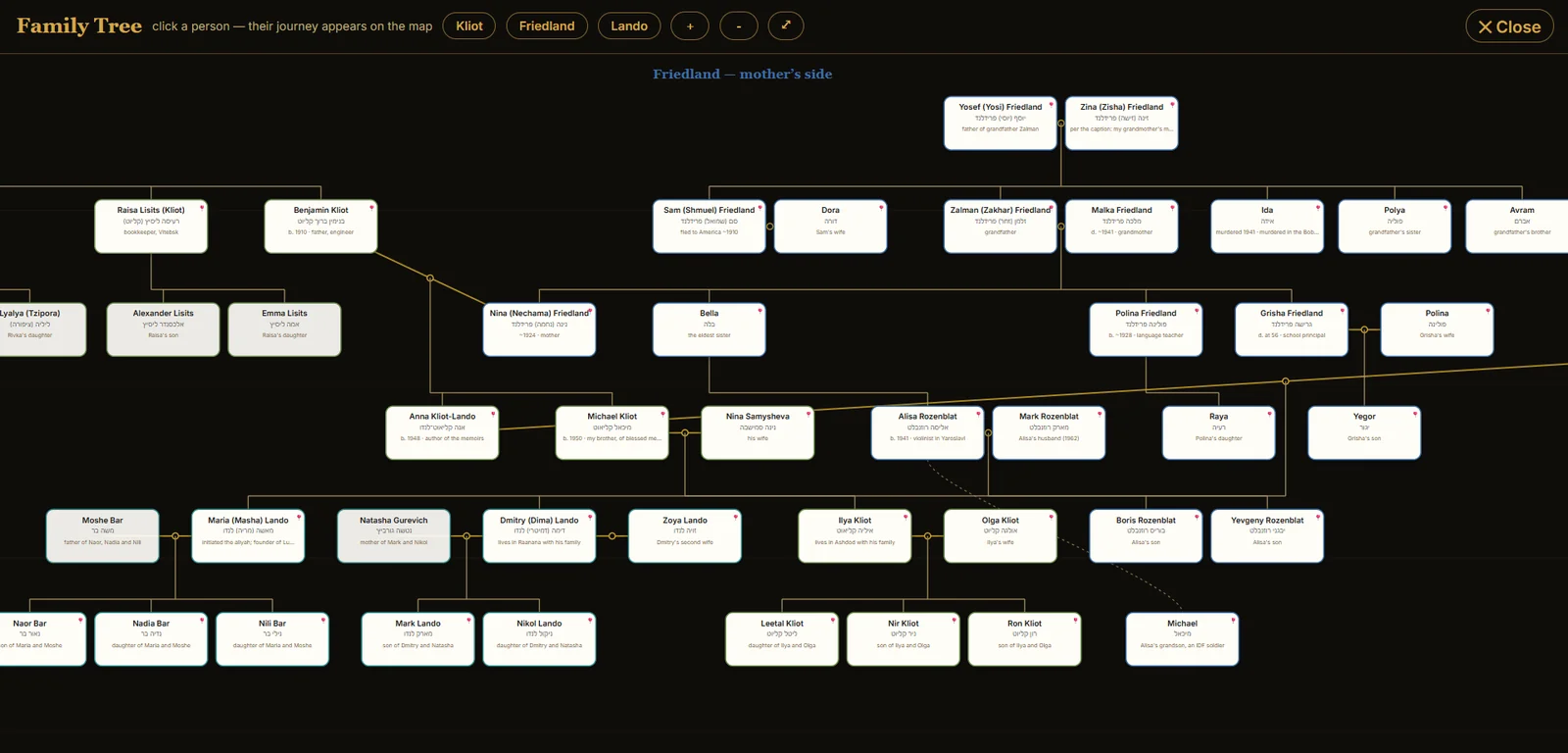
The family tree: eighty six people across three branches and five generations, each with their name in three languages and a pin linking them to the map

A family tree, interconnected with the map. Eighty six people across five generations in this one, each name in its own languages. Click any person and their journey draws itself, from the house they were born in to the country they ended in. The grandchildren find themselves at the bottom of it, which is usually the moment they start paying attention.

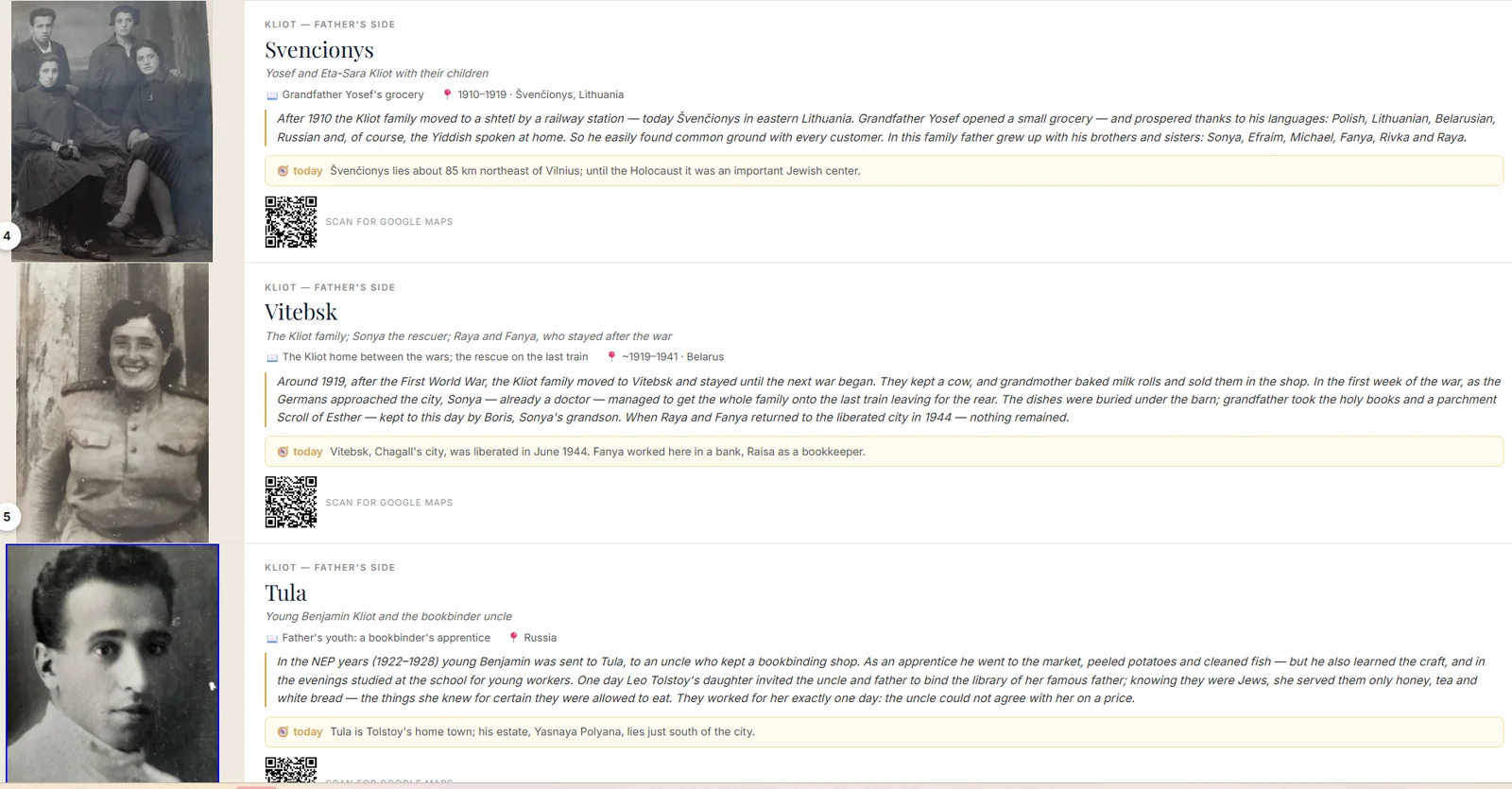
The exported PDF: each place laid out with its archive photograph shown whole, the story in full, and a QR code that opens the location

And it prints as a book. Any selection of places exports to a PDF: the photograph, the story in the family’s own words, and a QR code that opens the location. Send the printed copy to the relative who does not use a computer, and will not start now.

What is hard about a family that crossed a border

The hard part is not the story. It is the geography.

The town has three names

Places were renamed, absorbed, or moved from one country to another without anybody in them travelling anywhere. We find each one as it stands today, and say plainly what it was called then, and by whom.

The papers are unreadable

Documents in Yiddish, Russian, Polish, Hungarian, German or Hebrew, in a handwriting your children could not read even if they knew the alphabet. We read what you send and quote it exactly, never rewritten.

Nobody knows the route

Families rarely moved in a straight line. There were detours nobody talks about, years spent in places that were never home. Drawn in the order it actually happened, the road tends to surprise the family that walked it.

We research each place in the language of the place, not only in English, because the local record is usually the one that still remembers. Where a town no longer exists under any name, the card says so, rather than quietly pointing at somewhere nearby.

You are not going back. That is not what this is.

Plenty of families left because staying was not safe, or not possible, or not survivable. They were right to leave. A map of where you came from is not longing for a place that was cruel to your family, and it is not a suggestion that anything back there was better.

It is the opposite. Drawn in order, the journey shows what it cost to get here, and how far your grandparents carried the family before they handed it to you. Your children see the leaving as clearly as they see the place. That is the part that makes them understand where they are standing now.

“I had no idea my great-grandmother was a soldier in the Second World War, at just eighteen years old!”

How it works

You send what you have. We do the rest.

01

You send your material

A memoir, an interview recording, a tree file, a folder of documents, or just a list of names and towns.

02

We research and locate

We find each place as it exists today, including towns that were renamed, and check every one against the record.

03

We build and translate

The map goes live on a private link, in the languages your family reads, with the tree, the path and the photographs in place.

04

It grows with your family

Once the family sees the map, new photographs and memories surface. One update round in the first year is included.

You do not need a written memoir

A list of names and towns, a few photographs with something written on the back, and one afternoon of what the oldest relative still remembers is a real beginning. Most families start with less than they think they need. The research is our part.

Tell us which languages the family reads and we confirm them in the offer, before you commit to anything. English, Russian, Hebrew, Spanish, French, Yiddish and others. If the grandparents read one language and the grandchildren read another, that is the normal case here, not a complication.

Where you are does not matter, and neither does where the family ended up. Everything happens by email and by link, whether the family landed in New York, Toronto, Melbourne, Tel Aviv or Berlin, and whether they are now spread across all five.

What it costs

One payment. No subscription, ever.

A map built from a written family history starts at $3,000. It is commissioned work, made once for one family, not a template. Something the family keeps, and hands on to people who are not born yet.

First Chapter

$195
five places, one payment

You do not have to decide about the whole family today. Send us five places. The town your grandmother was born in. The port they left from. The city they waited in. The street they first lived on here. We research each one, find it even if it has been renamed twice, and put all five on a real map with your family’s own words beside them.

One language, ready in a week. If you go on to the full family map afterwards, the whole $195 comes off the price.

Five researched places on a map, and that is what it is. The family tree, the whole journey drawn in the order it happened, the additional languages, the PDF book and the update round belong to the full map. This is the way in, not a smaller version of it.

A Family Story Map

$3,000

You already have the story somewhere: a memoir, a recording, a tree file, a folder of documents in three alphabets. We do the rest.

What is included

  • Every place read out of your material, located and verified, including towns that were renamed
  • One language, and up to 40 places and 100 people on the tree, which covers most family histories
  • The family’s own words at each place, quoted exactly. In any additional language they are translated faithfully, never rewritten or embellished
  • Your own photographs, scanned, cleaned and placed where they belong
  • Where the family has no photograph of a place, we search for a freely licensed historic image of it and credit every one. Not every place has a surviving picture, and where none exists the card says so
  • A line on each place as it stands today
  • The family tree, linked to the map: tap a person and their journey draws itself
  • The whole journey as one path, in the order it happened
  • A PDF book, laid out place by place, each with its photograph, its story and a QR code that opens the location
  • Where the record is unclear, or two sources disagree, we come back to you rather than guess
  • One update round in the first year. Once the family sees the map they start remembering, and everything they send in that first year goes in at no extra cost

Add to any map

Each additional language, produced in full: the stories, the tree, the interface and the PDF book$1,000
A larger family: more than 40 places, or more than 100 people on the treepriced individually
A further update round: everything the family has sent since, added in one pass, in every language your map carries. Bought when you want one, never on a schedule$600

Tell us which languages your family reads and we confirm them in the offer, before you commit to anything.

Yours to keep

  • You pay once. Hosting is included for ten years and there is no annual fee.
  • You get a copy you can keep. The finished map is handed over as files you can download and host anywhere. If Ludara ever stops, your family’s map does not.
  • The material stays yours. Your photographs, your text, your family’s words, never licensed, sold or used anywhere else.

Questions we are asked

Questions from families who left.

Is this genealogy?

No. We are storytellers, not a genealogy service. A genealogist gives you names and dates on a chart. We take the story you already have, or the fragments of it, and put it back on the map of the world your family actually crossed, with their photographs and their own words at every place. If you already have a tree, we build on it rather than repeat it.

The town was renamed, or it is in a different country now. Can you still find it?

That is the ordinary case, not the difficult one. Towns were renamed, absorbed, or moved from one country to another without anybody in them travelling. We find each place as it stands today, say plainly what it was called then, and research it in the language of the place, because the local record is usually the one that still remembers. Where a town no longer exists under any name, the card says so rather than pointing at somewhere nearby.

We only know the country, not the village. Is that enough to start?

It is enough to start. Bring what you have, including the uncertain parts, and we will tell you honestly what can be located and what cannot. Where the record is unclear, or two relatives remember it differently, we come back to you rather than choose.

Our documents are in Russian, Yiddish, Polish or Hebrew. Nobody in the family reads them.

Send them. We read what you send and quote it exactly, never rewritten, and the map itself can be produced in several languages at once so the grandparents and the grandchildren read the same map, each in their own.

Does it matter that we live in the United States, Canada or Australia?

No. Everything happens by email and by link, wherever you are and wherever the family ended up, and whether they are now spread across several countries. That is the usual case here.

Is it about missing the old country?

No. Plenty of families left because staying was not safe, or not possible, and they were right to leave. Drawn in the order it happened, the journey shows what it cost to get here and how far your grandparents carried the family before they handed it to you. Your children see the leaving as clearly as they see the place.

Private by default

A family story is not a publication. Every map ships on an unlisted link that search engines cannot find, and you decide who gets it. If you want it tighter than that, say so:

  • An unlisted link. Not indexed, not searchable, shared only by you.
  • A password. One word the family shares, and nobody else can open the map.
  • A named list. Access limited to the people you name.

We never publish a family’s map, quote it, or show it as an example without written permission. If you would rather it were public, that is your decision, not ours.

Tell us about your family.

Write a few lines about where the family came from, roughly how many places and how many generations, and which languages they read. If all you have is a country and a surname, say that. We answer within one business day with a price offer, and we will walk you through a finished map first.

No commitment. Your material stays private.

Message sent

We will be in touch within one business day.